Finding our way to The Way one situation at a time. I don't know how great it will be, but I expect it will be interesting, and I look forward to it going on past all reason because wonder is just that way. Are you coming or not?
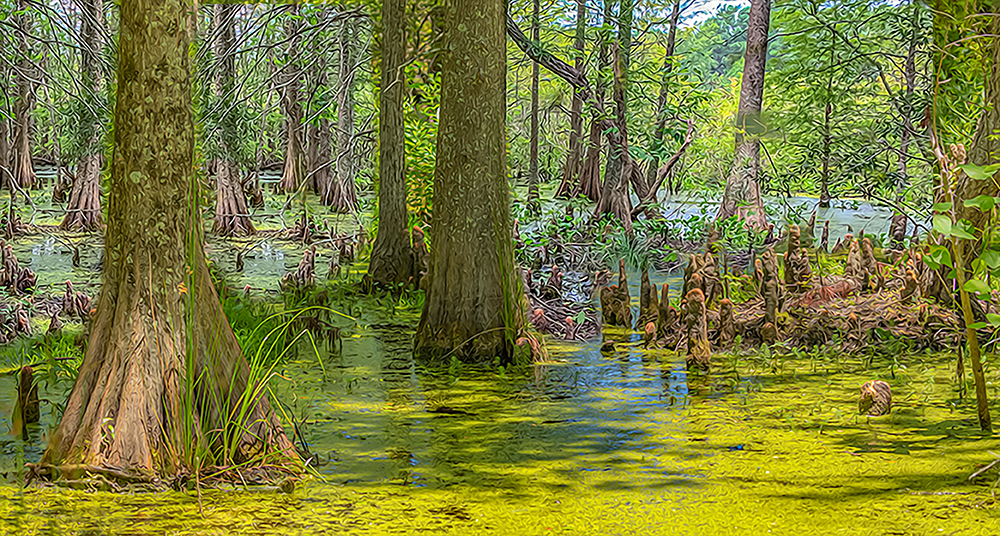
Low Country Cypress Swamp Oil Paint Rendered — South Carolina
Vitality,
integrity,
sincerity,
heart.

Foundational principles
for guiding our way
through life.

Original nature.
Innate virtues.
How we do
what we do best.

Aligned with the center/source,
balanced,
in harmony,
inner and outer,
yin and yang.

The way to The Way
is The Way.

Wanting more,
with eyes on other things,
distraction,
disruption,
disharmony,
destabilization.

The way to the wasteland
is always at hand.

Focus,
attention,
intention,
deliberation.

Daily tasks
for the work
of seeing/hearing,
knowing/doing/being.

Emptiness,
stillness,
silence.

Companions for the journey,
every day.
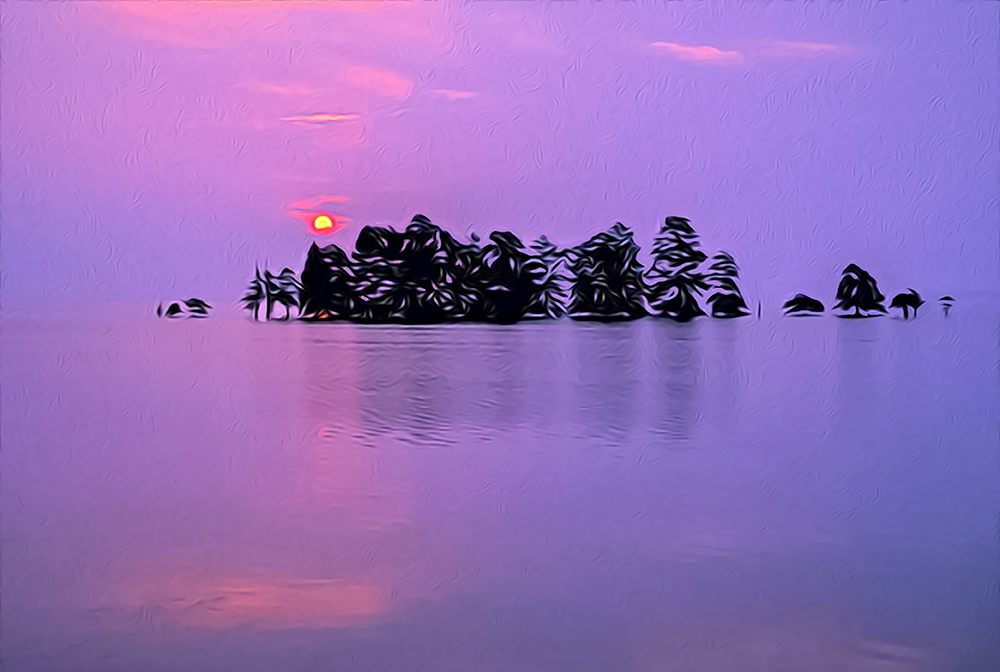
Lake Mattamuskeet Sunrise07/20/2006 Oil Paint Rendered — Mattamuskeet, North Carolina
Our response to the circumstances/situation
can interfere with/prevent
the solution to the circumstances/situation.

Our influence is the uncertain element
in the work to balance the equation
that is every situation as it arises.

In light of Shel Silverstein's observation,
"Some kind of help is the kind of help
that help is all about,
and some kind of help is the kind of help
we all could do without,"
what kind of help do we bring to bear
upon the circumstances we encounter in a day?

How would we know?
How do we evaluate the impact
of our own influence?
What kind of shadow
do we cast on the circumstances at hand?
How do we know?

We might try walking around
watching ourselves in action,
just observing
without judgment or evaluation.
Just seeing.
Just hearing.
Just knowing.
Just reflecting.

What role do we play
in each situation throughout the day?
What are we trying to do?
How are we trying to do it?

What kind of help we bring to bear
on the situations we encounter?
How is it received?
What is the outcome?

How often are you sure what needs to be done?
How often are you unsure?

What types of situations have the best outcome
from your point of view?
What types have the worst outcomes?

Seek your own insight
as an interested observer.
What do you have to say in the matter?
How do you rate the value
of your own participation
in the situations arising through the day?

What suggestions does your inner observer
have to offer?

Keep the conversation going
through all the days left to be lived.
And see what your nighttime dreams
have to offer over time.

See where it goes...
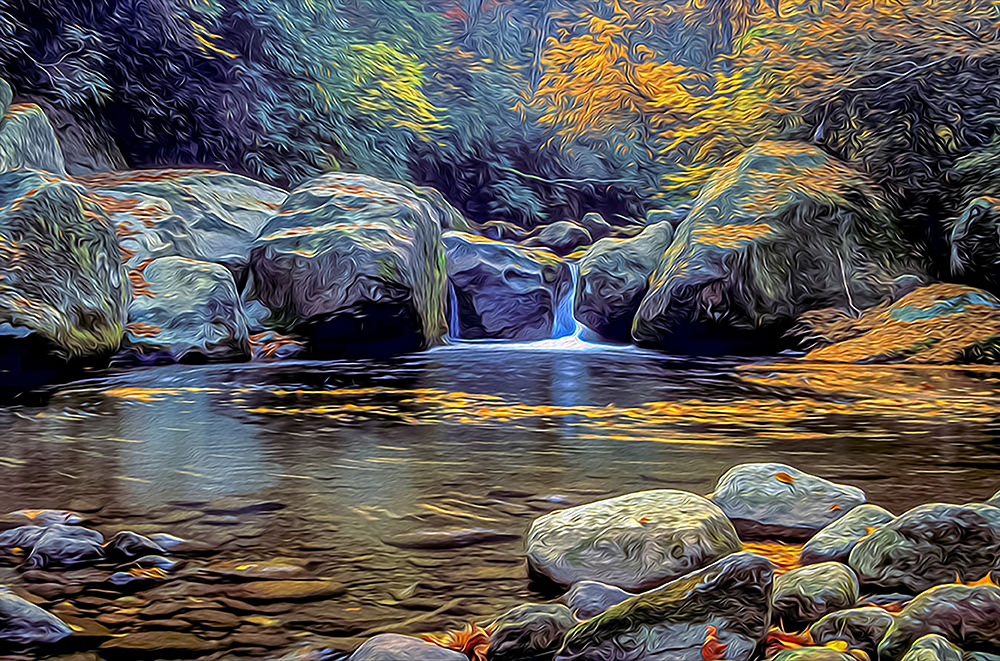
Midnight Hole 11/03/2001 Oil Paint Rendered — Big Creek, Great Smoky Mountains National Park, Waterville, North Carolina
Vitality leads the way.

Go where there is life,
where life resides,
living from your heart
all the way,
and all will be well,
and you will be just fine.

It is when we begin to
contrive and connive,
plan and scheme,
devise agendas
and think ahead
so that if we do this
and this
then that will happen
and we will be deliriously happy at last
that things begin to crumble
and go to pieces as we watch.

Deliriously happy
cannot compare with being
in the center of our original nature,
playing with our specialties
and enjoying the wonder
of doing the things we do best
in each situation as it arises
come what may.

Integrity,
sincerity,
spontaneity,
do not allow for check lists
and time frames
organized by five year plans.

What it is time for here/now
is all we need to know.
Doing what is called for
in response to what's what
is enough for today.
Tomorrow can wait for tomorrow.
Moraine Lake Afternoon 09/19/2009 Oil Paint Rendered — Banff National Park, Canadian Rockies, Alberta
This image makes me want
to sit on the big log on the left
and wait until tomorrow
so I can do it again.

Scenes like this do "it" for me.
Going to heavy weight fights,
or attending the Super Bowl don't.

This "me/not-me" sense of who we are
is but one of the expressions of mystery
in our life and world.

What is with the connections,
and the un-connections?
They stand for me as hints
of the Transcendent aspect of existence.

There is more to everything than meets the eye.

Who doesn't have experiences with Grace?
Or the sense,
in looking back over our life,
of mysterious coincidences at work
as though everything were orchestrated,
choreographed,
guiding us all along the way?

This sense of the "as though"/"as if"
has been strong enough at various places
in past ages
for our ancestors to posit the existence of God,
and point to these experiences as evidence
of God's providence and presence.

The "as though/as if" become rock solid facts
in no time at all,
just as the ever-present God becomes a fact,
with us having to have explanations
for our experiences,
rather than being awed with wonder and amazement,
and thrilled by the impact of our experiences
in the rear-view mirror of life.

It is all the other side of normal, apparent, reality,
the Transcendent glory of it all,
which we vandalize with our graffiti of explanations,
interpretations and commentary.

"Wow!" is enough
and all we need to say.

And maybe sitting throughout the night,
so we can say it again tomorrow.
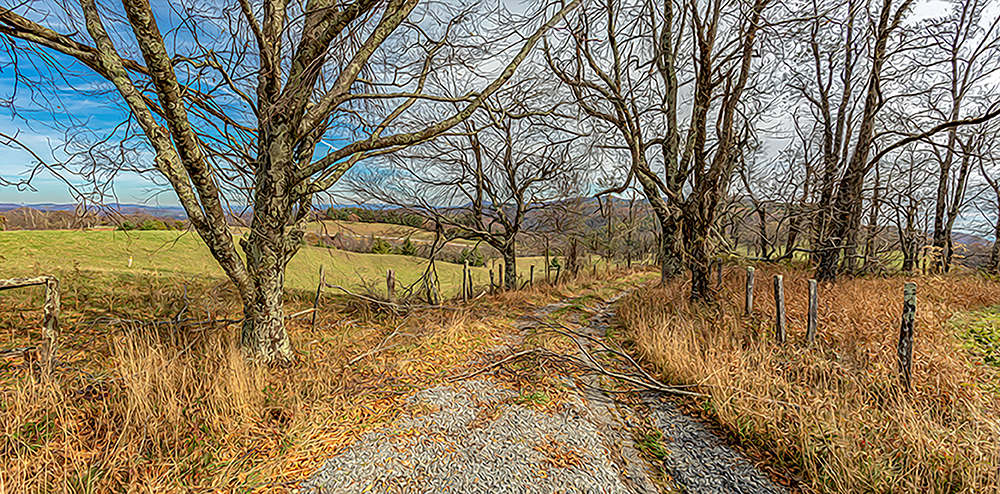
November 04 11/04/2019 Oil Paint Rendered — Blue Ridge Parkway, Doughton Park, North Carolina
In my opinion,
all theology consists of
collections of opinion about opinions (Hearsay).

Roman Catholic opinion is different
from Protestant opinion.
Reformed opinion is a form of Protestant opinion
that can be sub-divided into a myriad
of somewhat related opinions.
The same goes for Methodist and Baptist opinion,
Pentecostal and Etc. opinion.

Philosophy also consists of
collections of opinion about opinions (Hearsay).

Both Theology and Philosophy come to grief
with four questions:

How do we know?
Who says so?
How do we know they know
what they are talking about?
Why would anyone take anything on faith?
(Which would be answered with,
"We are at the point of having to do something
and we don't know what will happen no matter what we do,
so we have to make our best guess about what to do
and trust our luck,
and see what happens,
and we will know more after making the experiment."

Science is grounded on making experiments on someone's
opinions in order to verify what can be known
and separate that from what will have to--
for the time being--
remain unknown/unknowable.)

The statement:
"The stove is hot,"
can be verified independently
by everyone.

Statements of Theology and Philosophy
have to be "Taken on faith"
by those subscribing
to the Theology/Philosophy in question.

Why would anybody ever take anything "On faith"?
Because they are too lazy or disinterested
to think things through for themselves,
in an "Okay, if you say so," kind of way.

Immanuel Kant has some interesting things to say
about the "Transcendent" and the "Transcendental."
He says, basically,
that we can think/talk about the "Transcendental,"
but, because the "Transcendent" is Transcendent,
we cannot think, and therefore cannot talk,
about the "Transcendent."

And, in my opinion, that is where it ends--
in knowing what we can talk about,
and what we cannot talk about.
And not talking about what we cannot talk about,
beyond asking the four questions,

"How do we know?"

"Who says so?"

"How do we know they know
what they are talking about?"

"Why would anyone take anything on faith?"
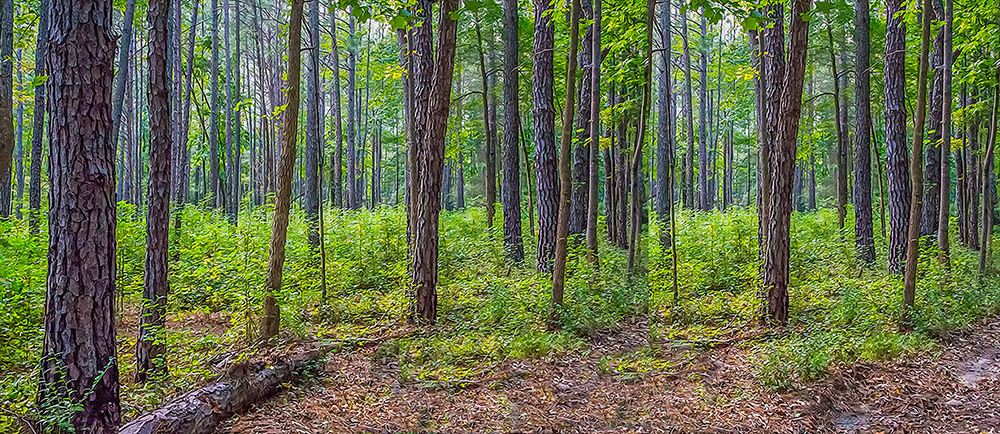
Piney Woods 09/23/2013 Oil Paint Rendered — Anne Springs Close Greenway, Lake Haigler Entrance, Rock Hill, South Carolina
Balance and harmony lead the way to The Way.
Noise, complexity and drama
destabilize and disrupt the flow of life,
and wanting what we have no business having
keeps the heaving waves of the wine dark sea
in constant motion.

We have to call a three day time-out
just to regroup and reorient our life
in the service of what matters most,
seeking the adamantine foundation
of our original nature
and our innate virtues/specialties/the
things we do well
in order to get back to the AUM
of the here/now
and be attentive to what is called for
in the situation at hand--
in a "Here we are, now what?" kind of way.

Being in tune with the circumstances
puts us in position to see what is happening
and what needs to be done about it--
with wants/desires/expectations/opinions
taking the back seat to what the situation requires
and one step at a time-ing it
to balance and harmony,
integrity/sincerity/spontaneity,
back into the flow of life and being.

It takes being mindfully aware of the development
of disruption
to keep things from becoming
wine dark sea crazy,
and that means being attentive
to what's what and what needs to be done about it
in each situation as it arises,
or it will be riding the rolling waves
between the clashing rocks again and again.
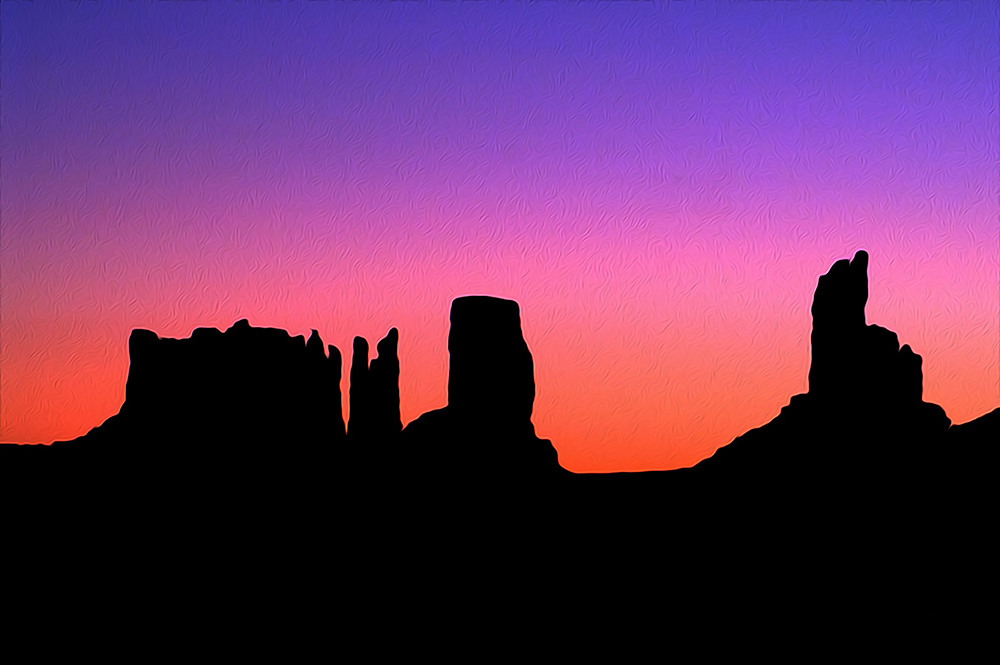
Monument Valley Dawn 05/26/2011 Oil Paint Rendered — Monument Valley Navajo Tribal Park, Arizona
Joseph Campbell made a comfortable living
telling people to follow their bliss.

Truth be known,
so did I.

Why would anybody pay anyone
to tell them to follow their bliss?

What could be more obvious than that?

It is like people paying you
to tell them to breathe.

What?

Here's my theory:
People are looking for relief
from their own lives--
one might say,
from their own miserable existence,
from their own tortured experience
of the day-to-day.

Somebody keeps buying alcohol
and pot at high rates of consumption.
Why?
Did no one ever tell them
to follow their bliss?
Did no one ever tell them
how to do that?

What is the problem, really,
that we are trying to escape/avoid?
The wrong kind of emptiness, perhaps?
The realization of the sorry ends
we serve with our lives?

The music and entertainment industry
floats on a sea of misery and discontent--
in the fans that keep them afloat,
and in their own dissatisfaction
with their own lives.

What's the source of the dissatisfaction?
Why aren't we all following our bliss?
What is the missing element
we keep spending money hoping to find?
How do we find it?

It is right here,
right now,
all the time!

It is the simple (and impossibly difficult)
shift in perspective
that sees things as they are
and as they also are,
and laughs at the wonder of it all.

What is the key to the laughter?
The carelessness of babies
and small children,
who laugh at nothing,
and enjoy themselves with a rag doll,
and being rocked,
and told stories.

Whence the seriousness
with which we go at life?

When following our bliss
is not serious at all?

What is with taking all things seriously?

Where is the laughter?
What form does our playing take?

When is the last time you played?

What is keeping you from learning
how to play with everything
just by the way you look at it,
see it,
think about it,
receive it,
respond to it?

And fold it into your life
of wonder and bliss?

It cannot be that easy, right?
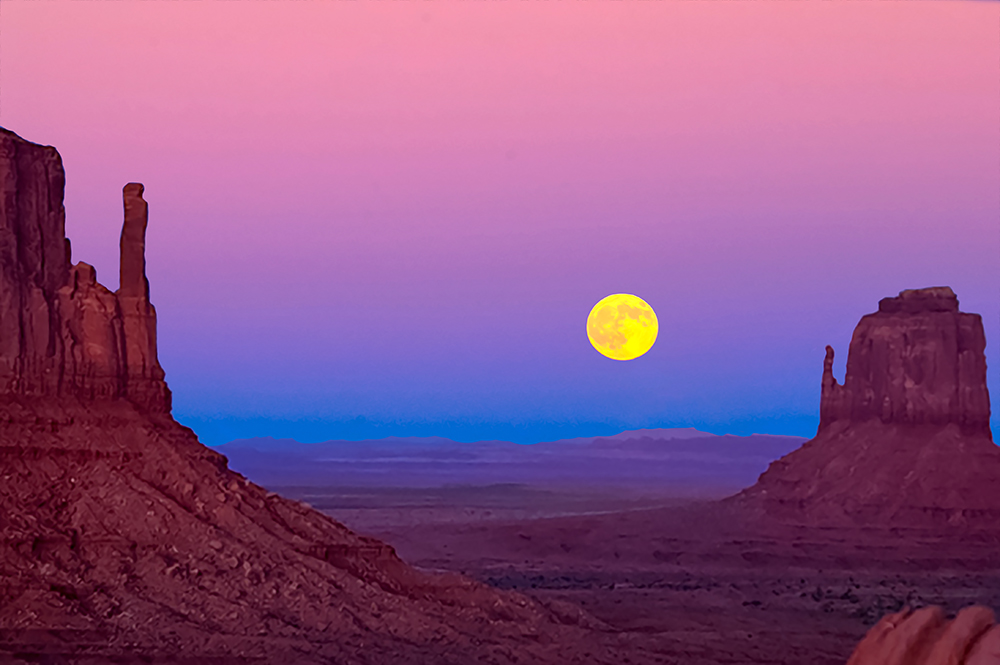
Moonrise at the Mittins 09/25/2007 Oil Paint Rendered — Monument Valley Navajo Tribal Park, Arizona
When we lose the flow,
the flow of life,
the joy of life,
the zest for living,
the sense of being one with a mission,
with a calling,
with a reason for being here/now...

When we lose that,
how do we get it back?
If we have never had it,
how do we find it?

We allow it to find us!

It could be a cup of coffee
that is calling,
and a cinnamon roll,
but whatever it is,
we know it is time for it,
and are eager to be at one with the game
which is "afoot."

When we lose that,
it is merely a matter
of emptying ourselves
of all that is stirring within.

An easy way of doing that
is two rounds of inhaling for a count of five,
exhaling for a count of five,
remaining between breaths for a count of five
and inhaling for a count of five.

Throughout that process,
we are generally empty of everytthing
but the count.

At the end of the second round,
we empty ourselves even of that.

Simply remain in that emptiness,
dismissing everything that comes to mind,
giving ourselves over to the emptiness,
the stillness,
the silence,
listening for what calls our name,
ignites our fire,
invites us to action,
the way a cup of coffee might,
or cinnamon roll...
Moonset 02 11/19/2019 Oil Paint Rendered — Edisto Beach State Park, Edisto Island, South Carolina
Transcendentalism appeared in New England
in the 1830's--
with Ralph Waldo Emerson and Henry David Thoreau
serving as its most recognizable proponents.

It did not last as a movement,
because it wasn't interested in lasting,
as in making disciples,
telling people why they ought to belong,
and competing for market share
via oratory and theology wars.

Their basic stance was to hold up a flower,
as the Buddha once did,
and say, "You can look at this flower
and see it,
or not see it.
That is up to you."

For them, transparency to transcendence
was everywhere
all the time.
It was only a matter of seeing or not seeing
what is "right there."
And doing or not doing
what needs to be done about it.

They realized that no one can be
talked into seeing,
or told how to see--
and certainly that no one can be told
what is to be seen,
or how it got there,
or what it means.

We "let the mystery be" (Iris Dement),
and do what we think needs
to be done about it,
knowing that thinking
we can say anything about it
is completely absurd,
because it is transcendent,
don't you see?

The transcendent is like the Tao,
about which Lao Tzu said,
"The Tao that can be said/told/explained/talked about
is not the eternal Tao."
Or, as Martin Palmer said,
"The path that can be discerned as a path
is not a reliable path."

That's Transcendentalism for you.
We see it or see it not.
And that's all we can say about it.

See?
Our Psyche is here to ground us
on the adamantine foundation
of our original nature
and the innate virtues/specialties
(The things we are good at/do well).

These form our character
and represent the boundaries,
the limits,
within which we live
in carrying out the business of life.

They are our anchor stone,
and serve as the source
of our confidence and strength,
our resiliency and our courage.

They are where we turn
when we have nowhere else to turn.

Our gifts are with us always,
and connect us at the level of the heart
with the transcendent reality
that shines through us
when we are being who we are
in the day-to-day affairs
of the same-old-same-old.

We are "transparent to transcendence"
when we are most like ourselves,
spontaneously,
in response to what is called for
in each situation as it arises,
sincerely,
naturally,
out of our own integrity,
our own nature.

There, we are god-like,
as Jesus was god-like,
and could say,
"When you have seen me,
you have seen the Father."

That is who we are
when we are being who we are,
moment to moment,
here/now.

The key is that we cannot live like that
in the service of motives and agendas,
purposes and goals,
that take us away from serving
our original nature and innate virtues
in conjunction with our Psyche.

When we do that,
when we live with eyes
on the life in Gay Paree
(Or its equivalent),
we are with Adam and Eve
in the Garden of Eden,
with eyes only for what we want,
and it is over our being
one with the Father.

So we have to be focused,
and our Psyche is our invisible friend
to assist us in remaining grounded
in our Anchor Stone,
and at one with the gifts
that came with us from the womb,
in being and doing what is ours to do
in the time left for living.
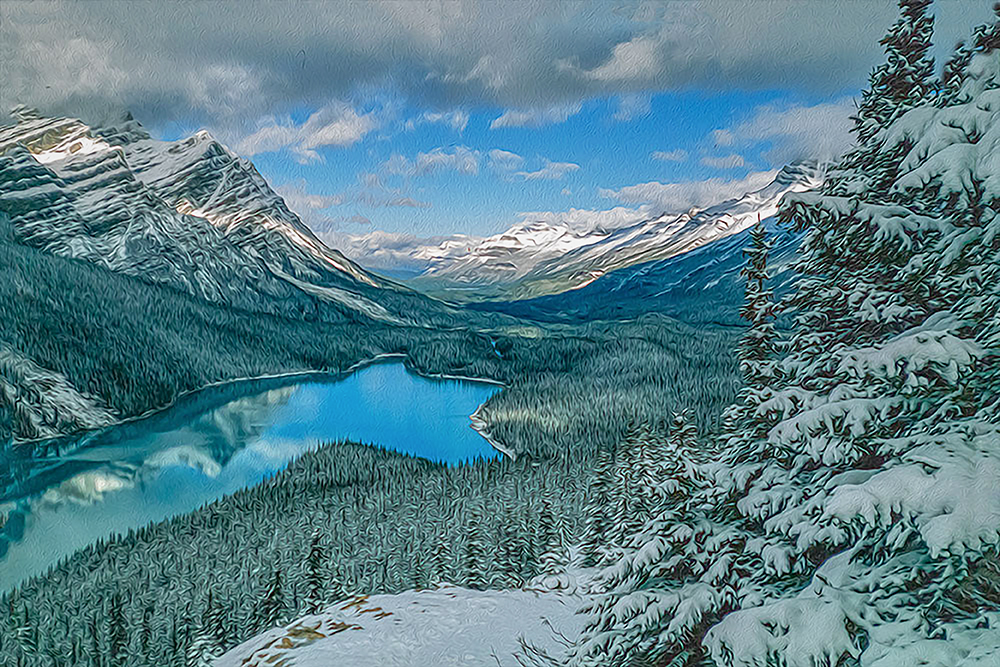
Peyto Lake 01 Oil Paint Rendered — Banff National Park, Canadian Rockies, Alberta
If the good we call good were good,
and if the right we call right were right,
societies around the world
would be equitable,
racism and sexism, etc.
would not exist,
and everyone would live
in the service of the best interest
of one another.

Third World countries
would not be ransacked and vandalized
by the rich and powerful nations,
and the dregs of humanity
would fare much better
at the hands or the well-to-do.

We don't have to look closely
to expose the fraudulent nature
of the good we call good
and the right we call right.

Who are we kidding?
Only ourselves.
What do we do about it?
Who are we kidding?
We like things just as they are.

Turning things around
begins with seeing things as they are.
When it doesn't pay to look.
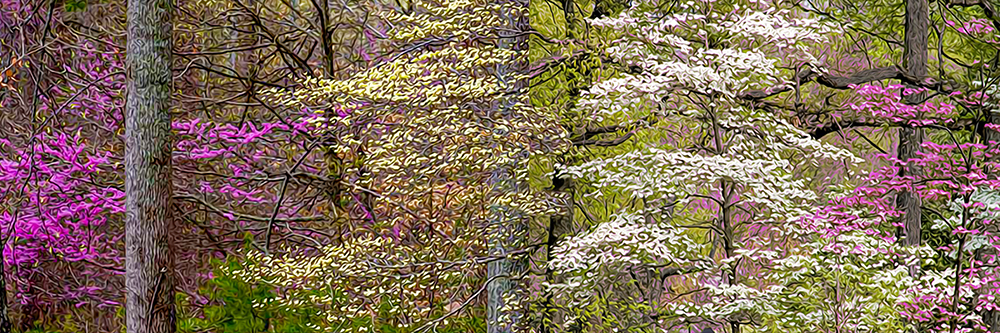
Dogwoods and Redbuds Oil Paint Rendered — Guilford Courthouse National Military Park, Greensboro, North Carolina,
The Psyche is sometimes referred to
as "our unconscious mind,"
(Because we are not conscious of it).

One of its functions
is to regulate/harmonize/balance
our conscious life
in conjunction with our unconscious
nature and virtues (specialties--
the things we do well).

Our nighttime dreams are one of the places
our Psyche addresses the excesses
and deficiencies of our conscious life,
lowering the peaks and raising the valleys,
so to speak,
of our life in the day-to-day world.

We can easily overwhelm our unconscious/psychic
needs and interests
with our bevy of fear and desire
and our dedication to serving our idea
of how out life ought to be
at the expense of all other concerns.

The Psyche compensates for our one-sided
(self-centered) tendencies
with dreams and symptoms that counter our
fascination with having/getting our way,
with signs and conditions
restricting our overbearing ways
and calling us back to the center
of life within the scope of our design
and capabilities.

It is wise to listen to our body
in terms of what it is saying and doing,
as a way of putting ourselves right
with ourselves,
and serving the ends which we are equipped
to exhibit and express
through the way we live.

In order to know what our Psyche knows,
we have to attend our dreams,
our intuition,
our instincts,
our feelings,
our moods,
and spend time
consciously and intentionally
with emptiness,
stillness
and silence
in a routine and regular way.

Making ourselves present with
what is present with us,
is putting ourselves
on track with our life,
and committing ourselves
to a lifetime of alignment,
allegiance
and alliance.



 Jim Dollar's Photography and Philosophy