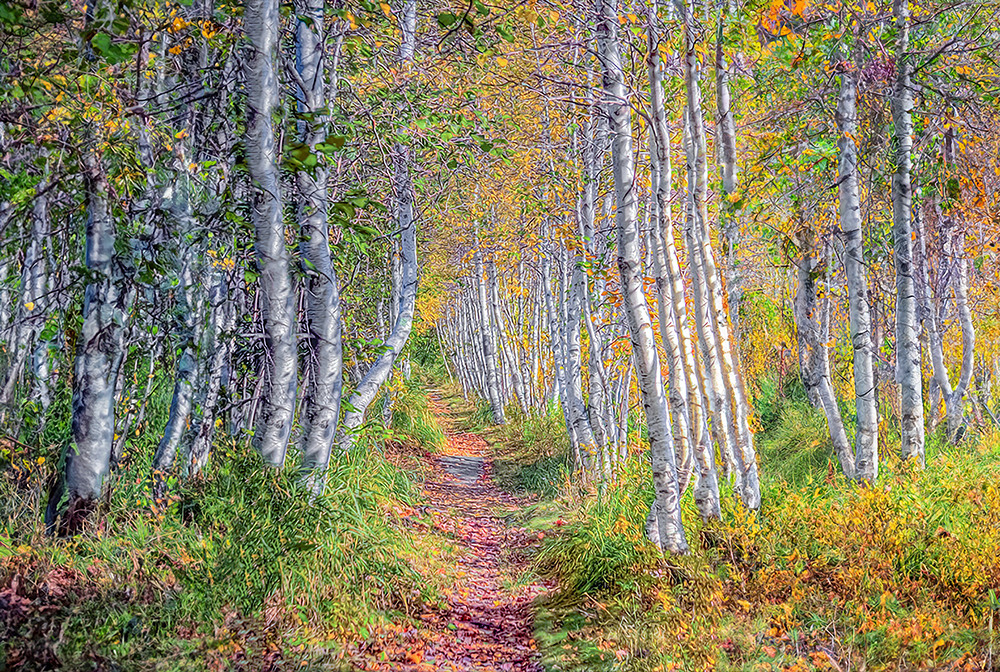
"The path that can be discerned as a path,
is not a reliable path" (Martin Palmer/Lao Tzu).

Which begs the questions:
"How good is a path that cannot be discerned?"
"What does 'discerned' mean?"
"How do we find our way,
looking for a path that cannot be discerned?"
"Where does this leave us?"
"What do we do, not knowing
whether or not it is the way,
the right way?"
Etc.

A path that can be discerned as a path
is someone else's path.
We are on our own
when it comes to finding our path.
What do we say is a path
and is not a path?

This question, "What do we say?",
leads us into emptiness
(Where we are empty of all emotions,
especially fear and desire,
all thoughts,
all we have been told
and think we know...
as empty as the space between breaths),
stillness
and silence,
waiting to know what we say,
waiting for it to emerge/arise/appear
uncontrived
to compel us to act,
knowing what is to be done here/now
"Like a person with their hair on fire
searching for a pool of water."

That is what we say.
How do we know?
Where does it come from?
How can we explain/defend/excuse/justify
our action?

In this, we are like Jesus going to Gethsemane
and Golgotha.

We go without knowing why
in the face of all the reasons to not go
because we know this must be done,
we don't know why,
or how we know,
or what makes us think so.

This is called making our own path,
when we do not know if it is actually a path,
and we don't let that stop us--
on the order of:
"It's the pirate's life for me, Gibbs.
I have no say in the matter.
Savvy?"
–0–
 Jim Dollar's Photography and Philosophy
Thank you!
LikeLiked by 1 person